
The UK Jobs Market: Employment Levels vs. Advertised Vacancies
- LiveWebChat
- Feb 23
- 2 min read

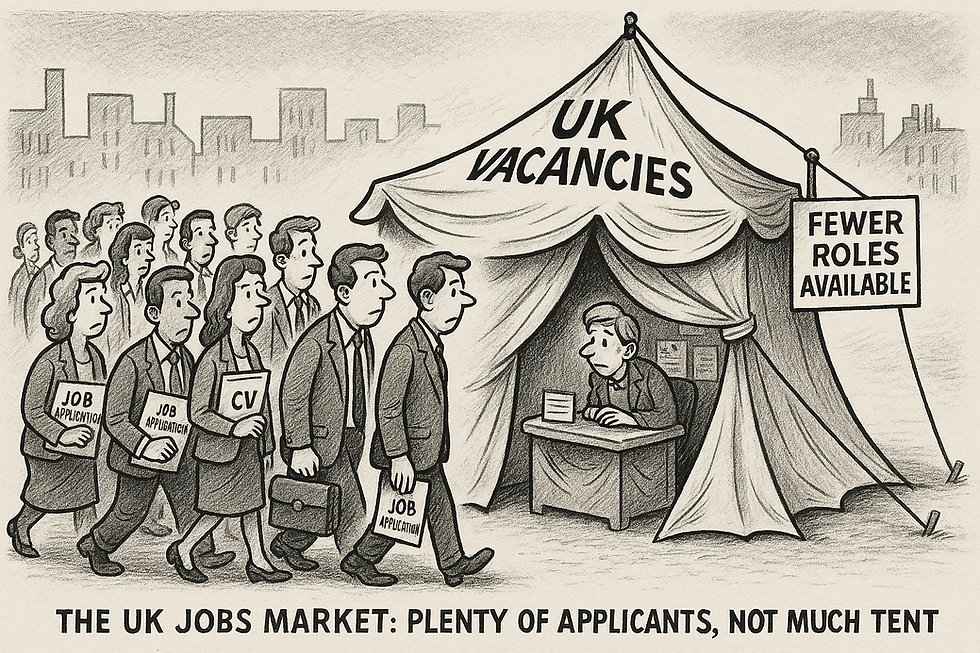
The UK labour market in early 2026 presents a complex picture: employment remains relatively stable, yet the number of advertised vacancies has fallen sharply, signalling a cooling jobs market and intensifying competition among jobseekers. Recent data from the Office for National Statistics (ONS) and major job‑market analytics platforms reveal a shift from the overheated, candidate‑driven market of the post‑pandemic years toward a more employer‑leaning environment.
Employment Levels Hold Steady
According to the Office for National Statistics’ February 2026 release, employment, unemployment, and economic inactivity rates remain broadly consistent with recent trends, suggesting no dramatic deterioration in the overall labour force position. The ONS notes that its latest estimates continue to track stable employment levels across the UK, even as other indicators—such as vacancies and redundancies—show signs of change.
This stability in employment suggests that while hiring appetite has cooled, employers are largely retaining existing staff. Redundancy levels remain within normal ranges, and labour‑market flows indicate that people are still moving between jobs, albeit at a slower pace than during the rapid post‑COVID recovery.
Advertised Vacancies Decline Sharply
In contrast to steady employment, the number of advertised roles has dropped significantly. Data from Adzuna’s UK Job Market Report (December 2025) shows vacancies shrinking for the fifth consecutive month, marking the biggest annual drop of the year. The report highlights a notable rise in jobseekers per vacancy, reaching a four‑year high—an early sign of tightening conditions.
This trend has accelerated into 2026. By January, advertised vacancies had plummeted to a five‑year low, falling below 700,000 for the first time since early 2021. Adzuna reports a 3% month‑on‑month decline, a 16% drop compared to January 2025, and a 19% fall over the preceding six months. With more than two jobseekers now competing for each available role, the balance of power in the labour market has shifted noticeably.
Sector and Regional Dynamics
The contraction in vacancies is not uniform across the economy. Adzuna’s data shows that retail hiring has softened, likely reflecting cautious consumer spending and seasonal adjustments, while tech roles have seen a modest uptick, suggesting pockets of resilience in high‑skill sectors.
Regionally, Yorkshire has experienced the fastest fall in vacancies, whereas cities such as Cambridge, Guildford, and Oxford still report more jobs than jobseekers—an indication of persistent demand in knowledge‑intensive local economies.
What This Means for Jobseekers and Employers
For jobseekers, the tightening market means increased competition and potentially longer job searches. The average time to fill a role has already dropped to 35.9 days, suggesting employers are becoming more decisive and selective.
For employers, the decline in vacancies may reflect caution amid economic uncertainty, but it also presents an opportunity: with more candidates per role, businesses can access a deeper talent pool than at any time in the past several years.
Outlook
While employment levels remain steady, the sharp fall in advertised vacancies signals a cooling labour market that bears watching. If vacancy numbers continue to decline, pressure may eventually spill over into employment figures. For now, the UK jobs market sits at an inflection point—stable but tightening, resilient yet showing clear signs of slowdown.


